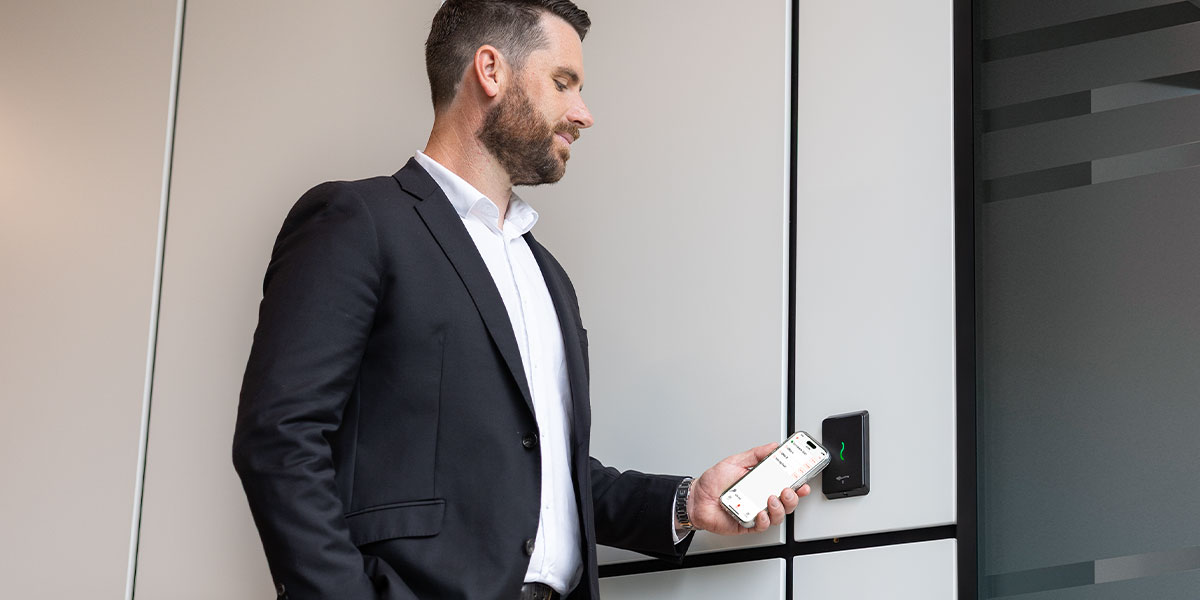
Three core decisions help shape the right door access control system for a commercial site. The first is how many doors you are protecting today and expect to add later, the second is which credential suits the traffic and security level of each door or site, and the third is whether on-premise, hybrid, or cloud-based management fits your team. This guide covers each in turn and what drives cost up or down.
What is a door access control system?
A door access control system is hardware and software that keeps a door locked until someone presents a valid credential such as a card, code, phone, or fingerprint, and records every entry as it happens. For most commercial buyers, the real question is how to move off mechanical locks and onto a networked, auditable system without over-buying or under-speccing it.
How does a door access control system work?
Core hardware: credentials, readers, controllers, locks
Every system is built from four parts. A credential (card, fob, code, or phone) identifies the person, a reader that captures it at the door, a controller that checks it against stored permissions, and a lock that carries out the decision.
Locks come in two types. Fail-safe locks unlock when they lose power, prioritizing egress. Fail-secure locks stay locked, prioritizing security. Which one a given door needs comes down to fire code. A backup power source keeps locks and controllers running through a power outage and a controller that loses its network connection keeps making access decisions from its stored permissions. The fail-safe or fail-secure choice matters when all power fails.
That offline resilience sits in the controller. Gallagher Security’s Controller 7000 range supports up to 2,000,000 cardholders and stores up to 1,000,000 offline events locally if the server connection drops, so a site keeps its access history during an outage.
The software and management layer
Management software is where someone actually runs the system. It sets permissions, provides a live view of access events, runs audit reports, and adds or removes credentials remotely rather than touching hardware at every door. Gallagher Security splits this across two platforms. SMB is cloud-native and mobile-first, for sites with straightforward needs and no on-site server. Command Centre suits enterprise and high-security sites with more complex requirements. You can install Command Centre on-prem using your own servers, run it within a hybrid architecture adding cloud services as your sites need them, or host Command Centre in your own cloud account, like AWS or Azure. Each is purpose-built for a different level of operational complexity.
Security data living off-site is often the first objection to cloud-based management, in all scenarios you still own and host your data. Gallagher-hosted cloud services are also SOC 2 Type 2 certified and Gallagher Security is also the only physical access control manufacturer worldwide certified to this full combination of standards: ISO 27001, SOC 2 Type 2, FIPS 140-3 & 201-3, CAPSS, AACS, and EN 50131-4.
Types of door access control systems by credential
The right credential depends on the door or site. There isn’t a universal best option.
Keycards and fobs (RFID)
Keycards and fobs are the most cost-effective option and suit high-traffic doors well, since tapping a card is faster than typing a code. There is a physical trade-off as lost cards need replacing and managing which creates added cost and risk. Older 125 kHz proximity cards are still common, but someone with the right hardware can clone them. Gallagher Security recommends MIFARE DESFire EV3 for sites without federal PIV requirements. It carries Common Criteria EAL5+ certification and offers a longer security lifespan than Classic or 125 kHz formats.
PIN and keypad
A PIN or keypad is the lowest-cost option, but it doesn't identify an individual, only whoever knows the code. That rules it out anywhere you need a per-person audit trail, since a shared code can't tell you who walked through.
Mobile credentials
Mobile credentials turn a smartphone into a credential over Bluetooth or NFC. Gallagher Security’s Mobile Connect app delivers this at Gallagher, Aperio, and SALTO BLE readers. Adoption of mobile credentials is growing, but unevenly. Gallagher's 2026 Security Industry Trends Report found 13% of End Users have already adopted mobile credentials, and while 39% now say they're likely to (up from 33% on the previous year), the share saying they're unlikely also grew, from 27% to 48%. The market is splitting, not simply shifting to mobile.
Mobile credentials are most suitable for modern or premium workplaces where a smartphone-as-badge fits the user experience and sites that already have their own app, like universities or multi-tenant buildings, where access can fold into an existing student or tenant app rather than issuing a separate card.
Biometrics
Biometric credentials, fingerprint or facial recognition, offer the highest assurance since the credential can't be lent, lost, or guessed. That suits server rooms and other high-security interior doors better than a main entrance, where the extra verification time slows everyday traffic more than it's worth. It's a speed-versus-security trade-off, not a case of biometric being most secure everywhere. Gallagher Security’s biometric integration handles enrolment and template management directly in Command Centre.
Which credential is right depends on the site. A government facility might require a a specific issued card such as PIV, while a multi-tenant office is more likely to land on a mobile credential.
Choosing a system architecture: single-door vs. networked, on-premise vs. cloud
Single-door vs multi-door systems
A single standalone controller suits one door, like a server room, or as a cost-effective option for adding an extra door to a sites system. Single door access control also works at sites without a controller cabinet, because the Power over Ethernet (PoE) variants need no separate power supply or cabinet. Once you're managing multiple doors, floors, or buildings, a networked system earns its keep by giving you one place to set permissions and pull reports instead of managing each door in isolation. Gallagher Security's access control range scales from one door to thousands on the same platform.
On-premise vs cloud-based management
On-premise management gives more customization and keeps data on infrastructure you control, at the cost of ongoing maintenance. Cloud-based management enables you to centralize hosting, manage sites remotely, and use existing cloud infrastructure provided connectivity is reliable. Command Centre covers on-premise, hybrid, and cloud management, the right starting point depends on your site's needs today.
Christchurch International Airport shows what that looks like in practice: Gallagher Security has been its security partner for over a decade, expanding Command Centre as needs have grown.
Choosing the right system for a commercial building
Assessing your doors and entry points
Before you request a quote, work out how many doors need control and how many cardholders you will need, including how fast your staff numbers are likely to grow. Then work out the controller-to-reader ratio across every door, and check whether cabling already reaches each door or you need new cabling. With those answers in hand, a quote reflects the job you need done.
Planning for scale
Think beyond today's door count. Adding a wing, a floor, or a second site later is cheaper if the controller and software you choose now have headroom for it. The same applies to cardholders and credentials, so build in room for your expected staff growth.
Integration with existing systems
A door access control system rarely runs alone. Gallagher Security’s Command Centre integrates with video management platforms including Avigilon, IDIS, and Salient; elevator systems from Schindler, KONE, TKE, and Otis; wireless locks from Aperio, ASSA ABLOY, Allegion, SALTO, and iLOQ; plus intercoms, biometric readers, and parking or vehicle access, all managed from one platform instead of separate logins and reports.
What affects the cost of a door access control system
Door access control pricing has no single sticker price. It depends on door count, the number of controllers those doors require, credential type and its replacement cost at scale, whether you need new wiring, and whether you're buying an on-premise system outright or a cloud subscription as well as any ongoing routine system maintenance costs.
The cost driver that surprises buyers most often is cabling. Quotes assume that existing wiring reaches every door, and when it does not, re-cabling an occupied building adds cost and downtime that rarely show up in the first estimate. Gallagher Security’s QuickSwitch range addresses this. Its boards match the footprints of common legacy controllers, so installers can switch in Gallagher hardware without modifying existing cabinets or wiring, which reduces installation time and downtime. QuickSwitch works with Controller 7000, so a site can move onto that platform without re-cabling.
Pricing depends on your specific doors and credential choice, so a site-specific quote from a Gallagher Channel Partner gives you a real number.
Common mistakes to avoid when choosing a system
A few mistakes show up repeatedly in commercial deployments.
- Undersizing controller capacity, cardholder counts, and credential numbers for the doors and staff you will add next year, not just the ones you have today.
- Choosing a low-friction credential like a keypad for a door with traffic it was never built to handle.
- Skipping integration planning until after installation, when retrofitting video or elevator access costs more than planning upfront.
- Ignoring backup power requirements, so a mains outage becomes a security gap instead of a non-event.
FAQs
What is a door access control system?
A door access control system is hardware and software that locks a door until someone presents a valid credential, and it logs every entry as it happens. It replaces a mechanical lock and key with a system you can manage and audit remotely.
How much does a door access control system cost?
Cost depends on door count, credential type, and whether you run an on-premise or cloud-based platform, so no single figure applies across sites. A Channel Partner can price your specific doors and credential mix as well as estimate install and ongoing maintenance costs.
What's the difference between a keypad lock and a full access control system?
A keypad lock controls one door with a shared code and no record of who used it. A full access control system ties every door to individual credentials, logs every entry, and lets you change permissions remotely instead of rekeying a lock.
Can a door access control system integrate with video security?
Yes. Gallagher Security’s Command Centre integrates directly with video management systems, so access events and camera footage sit on the same platform instead of two separate logins, letting you pull up footage tied to a specific access event rather than scrolling through unrelated video.
How many doors can one controller manage?
Gallagher Security’s Controller 7000 range supports up to 10 wired doors, with multiple readers configurable per door, so one controller covers a meaningful section of a commercial site. A licensed option also extends a single Controller 7000 to up to 24 doors, without additional hardware. Larger sites simply add more controllers to the same networked system. Gallagher Security's SMB Controller 6000 range supports up to 30 doors.
Find the right door access control system for your business
The right system follows from your door count now and later, the credential each door needs, and the management model your team can run. Talk to a Gallagher Certified Channel Partner for a site-specific recommendation and quote, or explore our access control solutions to see the full range this guide has described.