Security Industry
TRENDS REPORT
2027
Gallagher Security’s Trends Report is an annual survey of global security professionals, now in its fourth year.
The 2027 report draws on 677 responses from global End Users, Channel Partners, Technology Partners, and Consultants, collected between June 1 and July 31, 2026. It finds that organizations have stopped waiting for uncertainty to pass and are moving forward with actions. Software upgrades and analytics now lead End User investment priorities, 53% of End Users report that teams outside security shape purchasing decisions, and yet responsibility for security outcomes remains unclear.
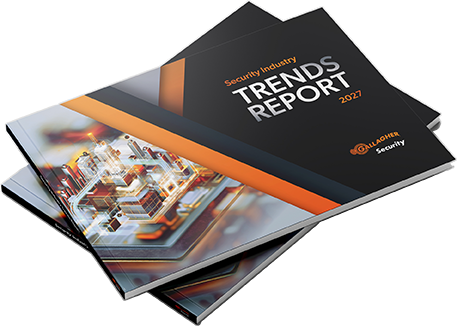
A must read for security leaders and decision-makers
Get a clear view of where the security industry is heading with the 2027 Security Industry Trends Report. This year’s research shows an industry moving from deferral to decision.
Cloud commitments are up, AI tools are in widespread use, and investment is moving from hardware toward software and analytics.
What organizations can’t yet confidently show is what those investments have returned, or who is accountable for the data and risks their systems now carry.
Drawing on global insights, the report tracks the physical security, technology, and corporate trends shaping the year ahead, and what they mean for the people who specify, install, service, and operate security systems.
Key trends in security for 2027
The 2027 report highlights the security trends redefining how systems are funded, evaluated, and owned. Key insights include:
■
The industry has stopped waiting
End User AI implementation crossed into the majority this year, rising from 44% to 62%. 41% of End Users now have a cloud deployment strategy, with a further 16% building one. Commitments are being made while the conditions around them are still taking shape.
■
Software and analytics overtake hardware
Security software upgrades take the largest share of End User investment mentions at 17%, followed by security and operations analytics at 13%, and hardware upgrades at 12%. Analytics climbed from fourth to second, the largest move on the list.
■
Security is absorbing obligations set elsewhere
Governance, risk, and compliance ranks third among the system features End Users value most (15% of mentions), ahead of cybersecurity (11%). Three years ago, it didn’t make the top five. Systems bought to protect people, sites, and assets are increasingly expected to produce evidence for compliance and sustainability.
■
Ownership is the unanswered question
53% of End Users report that teams outside security influence purchasing and planning. Executive teams (22%), finance (20%), and IT (19%) draw more mentions than facilities (17%), the function that has historically owned building security. IT strategy is also the leading driver of End User cloud deployment decisions, at 29% of mentions.
■
Automation becomes the defining goal
Increasing automation leads End Users’ three-to-five-year goals at 20% of mentions, pulling ahead of integrations after the two tied last year. With staffing shortages and skills gaps accounting for 32% of End User challenge mentions, automation is also their most-named response to the labor gap after training.
■
Proof of value is improving, but still scarce
23% of End Users are very confident measuring the ROI of their security systems, up from 15% last year. Yet 37% either don’t measure ROI or lack confidence in the measurements they have, leaving them unable to answer the question executive and finance teams are likely to ask.
Insights from industry experts
The report features perspectives from security leaders across roles and regions, offering real-world insight into how today’s challenges are shaping tomorrow’s solutions. From data ownership and cloud terminology to interoperability, industry events, and the hidden value of security, these voices bring depth and context to the data.
Featured in this report:

David J. Crawford
Data collection and the value of control
Production Manager - AI

Mariah Rimbert
When data becomes intelligence
Business Development Manager - Federal & Commercial

Lee Odess & Hilary Gallagher
Why we still need to be in the room… just better
CEO & Chief Operating and Marketing Officer – The Access Control Collective

Gordon Swallow
What we mean when we say "cloud"
Regional Business Development Manager - UKI

Tim Orr
The orphaned estate
Sales Manager
Security industry trends: 2026 vs. 2027
Here’s how key measures have shifted since the 2026 report.
| Measure | 2026 Report | 2027 Report |
|---|---|---|
End Users that implemented AI tools or integrations in the past year |
44% |
62% |
End Users with a cloud deployment strategy |
35% |
41% |
End Users with a cloud strategy in development |
12% |
16% |
End Users very confident measuring ROI |
15% |
23% |
End Users who don’t measure ROI or lack confidence in it |
46% |
37% |
Participants with active cybersecurity, governance, or compliance strategies |
73% |
76% |
Channel expecting customer security budgets to decrease |
8% |
15% |
End Users’ top three-to-five-year goal |
Automation and integrations (tied, 18%) |
Automation (20%) |
End Users’ top investment priority |
Hardware and software upgrades (15% each) |
Software upgrades (17%) |
End Users’ top integration |
Video |
Five-way tie at 19% |
Methodology and respondent profile
From June 1 to July 31, 2026, Gallagher Security surveyed 677 security professionals worldwide about the future of their organizations and the issues most likely to affect their security goals in the year ahead.
Respondents selected their own role: End Users (29%), Channel Partners (20%), Technology Partners (18%), Consultants (18%), and Other (15%).
Participation spanned the Americas (19%), Europe (15%), Australia (14%), Africa (13%), India (11%), New Zealand (11%), Asia (9%), and the Middle East (8%), with organizations of every size represented, from 1–20 people to more than 50,000.
Explore previous Security Industry Trends Reports
Interested in how security trends have evolved over the years? Explore our previous three reports to see how the security landscape has changed and how our predictions have held up.

Frequently asked questions (FAQs)
-
What are the latest trends in security?
The 2027 Security Industry Trends Report finds that organizations have stopped waiting for uncertainty to pass. End User AI implementation has risen from 44% to 62%, security software upgrades (17%) and analytics (13%) now lead End User investment priorities ahead of hardware (12%), and increasing automation is the top three-to-five-year goal (20%). Governance, risk, and compliance ranks third among the features End Users value most, while 37% of End Users either don’t measure ROI or lack confidence in their measurements.
-
Who contributed to the 2027 Security Industry Trends Report?
677 security professionals took part in the survey between June 1 and July 31, 2026, including End Users, Channel Partners, Technology Partners, and Consultants across the Americas, Europe, Australia, Africa, India, New Zealand, Asia, and the Middle East. The report also features expert insights from Gallagher leaders and The Access Control Collective, plus regional insights from Gallagher teams worldwide.
-
What changed between the 2026 and 2027 reports?
Automation pulled ahead of integrations as End Users’ top long-term goal, while software upgrades and analytics displaced hardware at the top of investment priorities. End User AI implementation rose from 44% to 62%, End Users with a cloud strategy rose from 35% to 41%, and End Users very confident measuring ROI rose from 15% to 23%. Integrations remain the most important feature when End Users select a system, for the second year running.
-
Can I access previous years’ reports?
Yes, the previous three years’ reports are available for download on our website, offering insight into how security trends have evolved.
-
How are organizations approaching cybersecurity, cloud, and AI in access control?
76% of participants report active strategies around cybersecurity, governance, or compliance. Among End Users with a strategy in place, data protection (25%), risk management (22%), audit and reporting tools (21%), access governance (20%), and Zero Trust (11%) lead, in the same order as last year.
41% of End Users have a cloud deployment strategy and a further 16% are building one. Among those without a strategy, lack of understanding or confidence is the most common barrier, and some organizations can’t use cloud at all due to data sovereignty, compliance, or internal policy requirements.
62% of End Users implemented AI tools or integrations in the past year. Participants expect AI to absorb volume, such as triaging alerts, sorting video footage, and reducing false alarms, while judgment and oversight stay with people. -
How are organizations measuring the return on security investment?
23% of End Users are very confident measuring the ROI of their security systems and 39% are somewhat confident. 16% lack confidence in their measurements and 21% don’t measure ROI at all. ROI also ranks last among End Users’ three-to-five-year goals at 5% of mentions, while Channel raises it nearly twice as often (9%).
-
What industries are most affected by these trends?
The trends discussed in the report impact a wide range of industries, including commercial buildings, data centers, government, healthcare, education, and critical infrastructure.
-
How can I cite or share data from the report?
You’re welcome to cite and share findings from the report with attribution to Gallagher Security, Security Industry Trends Report 2027. Many security leaders use the findings as an executive benchmark, comparing their organization’s investment priorities, ROI confidence, and cloud and AI readiness against global peers.
When citing figures, note that multi-select results are reported as a share of mentions and single-select results as a share of participants. -
When is the next report, and how do I take part in the survey?
The Security Industry Trends Report is published annually, and the survey for each edition runs mid-year, typically July-August.