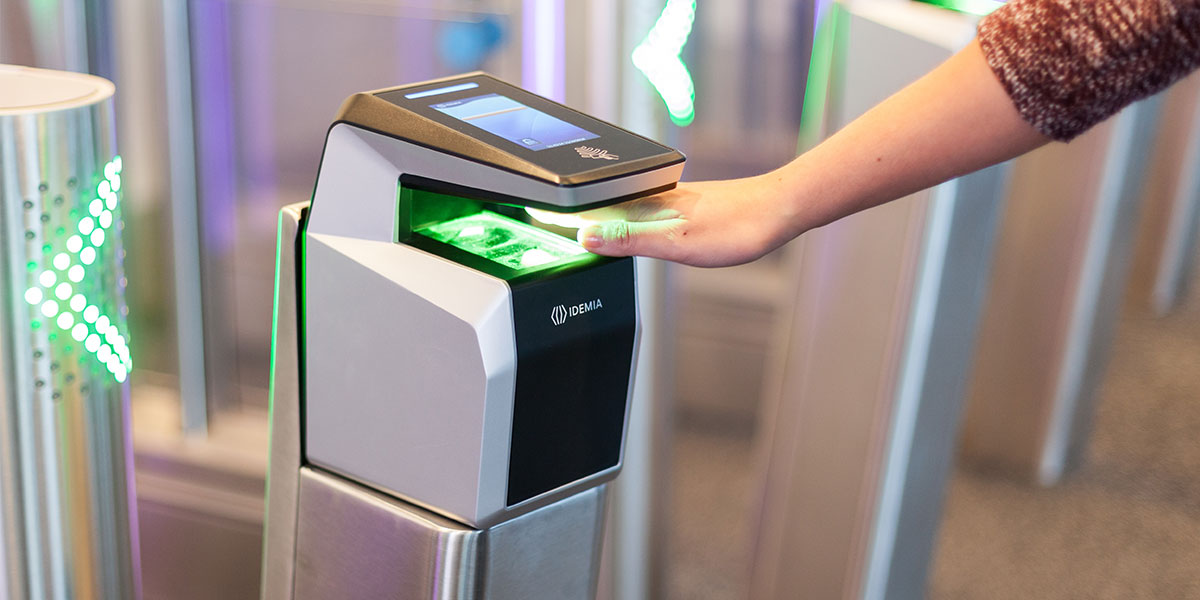
Remember that sinking feeling when you get to the office and realize you've lost your access card? That moment of inconvenience shouldn't be the reason someone can't get into the office. Or worse, the reason someone unauthorized can.
What if security was as intrinsic as your own fingerprint? Biometric access control solves both problems by tying entry to something employees always have with them: themselves.
This article covers how biometric access control works, the main technologies available, and the practical benefits for businesses that make the switch. If you're weighing up an upgrade to your current setup, here's what you need to know.
Key takeaways
- Biometric access control uses unique physical characteristics, such as fingerprints, faces or eyes, instead of cards, keys or passwords.
- Users enroll by scanning their features to create a template, then scanners compare new scans to stored templates at entry points.
- Common options include fingerprint, facial and eye scanning, with other methods like wave technology and vein matching.
- It removes the need for physical credentials that can be lost or shared, limiting access to enrolled people and reducing hacking or tampering risks.
What is Biometric Access Control?
A biometric access control system identifies people by their unique physical characteristics like fingerprints, facial recognition, or iris scans and grants access to restricted areas based on who they are, not what they carry.
Traditional methods like key cards and passwords can be lost, stolen, or shared. Biometric credentials can't be forgotten at home or handed to someone else, which removes a whole category of security risk.
How Does Biometric Access Control Work?
Setting up a biometric system starts with enrolment. A scanner captures each user's physical characteristics like fingerprints, eyes, or face, and converts them into a secure digital template stored in the system.
When someone requests access, a biometric reader scans the same characteristics and checks them against the stored template. If the data matches the stored template, access is granted. If it doesn't, entry is denied.
Types of Biometric Access Control
Businesses typically use a handful of core biometric technologies, each suited to different security needs and environments:
- Fingerprint door locks
- Facial recognition door locks
- Iris and retinal scan door locks
- Vein recognition
Fingerprint Door Locks
Fingerprint recognition is the most widely used form of biometric access control. It's familiar, fast, and accurate. A 3D scanner captures an enhanced image of the finger or thumb and converts it into a digital template built from multiple unique points.
When a user touches the reader, it scans their print against the stored template. If the characteristics match, the lock releases. Fingerprint access control is highly accurate and delivers reliable security across a range of environments. To get the best performance from a fingerprint biometric device, keep the sensor clean and free of debris.
Facial Recognition Door Locks
Facial recognition is a security measure that has evolved from high-security environments like casinos to everyday business applications. Today, technology has advanced so much that systems can map key points on a person's face to match their identity with incredible precision.
Facial recognition door lock systems use 2D or 3D images of a user's face as a template for authentication. When a user approaches a reader, the security software analyzes their facial features and sends a release signal when a match is confirmed. This entire process takes only a few seconds and often requires no physical contact with the reader.
For example, GardaWorld employed Gallagher's integration with IDEMIA's VisionPass for their headquarters in Montreal. This offered a smoother, more fluid experience for the many people coming and going each day. GardaWorld now enjoys the convenience of a unified solution, eliminating the need for separate systems. Staff move effortlessly within their headquarters, without the hassle and security risk associated with lost ID cards.
Eye and Retina Scan Door Locks
Eye scanners utilize high-resolution cameras and infrared light to create a detailed map of the eye. This information is translated into a template that serves as a unique credential for accessing biometric systems. It is important to distinguish between the two main types of eye scanners:
- Retinal scan locks use technology to identify individuals by capturing an image of their retinal blood vessel pattern at the back of the eye.
- Iris scan locks capture the unique patterns in the colored circles of an individual's eyes for biometric verification.
Other Types of Biometric Technology
While fingerprint, facial recognition, and eye scan door locks are the most common types of biometric entry systems, other technologies are gaining traction in specific sectors.
- Voice recognition involves storing voice samples in a database and analyzing them to identify unique speaking patterns. While less common for physical door access, it is used in various security applications.
- Vein matching analyzes patterns of blood vessels, usually in the fingers or palms. A reader shines infrared light onto the user’s hand and compares it with the biometric template in the database to grant access. This is particularly difficult to forge.
- Portable biometric access control systems are a recent development ideal for temporary sites. These devices usually employ a 4G connection to communicate with security systems rather than using a wired internet connection, making them perfect for law enforcement and construction settings where power or internet infrastructure is limited.
Advantages of Biometric Access Control
Biometric access control is gaining popularity as a security solution because it offers several distinct advantages over traditional methods.
Enhanced Security and Non-Transferability
One of the biggest advantages is that it eliminates the need for physical keys, swipe cards, or access codes that can easily fall into the wrong hands. Biometrics cannot be lost, stolen, or shared between employees.
Convenience and Efficiency
Users no longer have to remember passwords or carry physical keys. This creates a seamless flow of people through a building, reducing bottlenecks at entry points during peak hours.
Audit Trails and Accountability
With biometric access control, you know exactly who entered a specific area and when. This ensures a high level of security and significantly reduces the chances of hacking or tampering, providing clear audit trails for compliance.
Biometric technology, Tailored to Your Needs
The beauty of biometric access control lies in its versatility. Gallagher Security's comprehensive range of biometric access integrations caters to a diverse spectrum of security needs, from high-security government facilities to bustling corporate offices.
Whether you require multi-factor authentication for sensitive areas or convenient touchless access for common spaces, our team of experts can help you design a solution tailored to your unique requirements.
Contact our team to learn more about our suite of biometric integrations.
Frequently Asked Questions
How is a user's biometric data used in a biometric lock system?
During enrollment, a biometric reader captures a physical characteristic (like a fingerprint or iris pattern) and converts it into a mathematical "template" or hash. This template, not a photo of the trait, is encrypted and stored. When a user presents themselves at a door, the system compares the live scan against the stored template to grant access in milliseconds.
Do biometric access systems involve encryption?
Yes. Enterprise-grade systems, such as the integration between Command Centre and IDEMIA Biometric Access Solutions, use strong encryption to secure communication between the biometric reader, controller, and server. IDEMIA's biometric recognition algorithms are highly rated by the National Institute of Standards and Technology (NIST), an independent standards organization.
What is the difference between an iris scanner and a retinal scan access control?
While both are eye-based, they are different technologies. Iris scanners map the unique patterns in the colored circle of the eye and are often touchless and fast. Retinal scans map the blood vessel patterns at the back of the eye, requiring the user to look closely into a lens, making them highly secure but less convenient for high-traffic areas.
Are biometrics safe and legal for workplace use?
Biometrics are considered safer than cards because they cannot be lost, stolen, or shared. Regarding legality, privacy laws (like GDPR, DUAA, and other local Privacy Acts) require organizations to be transparent about data collection, ensure robust encryption, and typically offer an alternative (like a PIN) for those who opt-out.