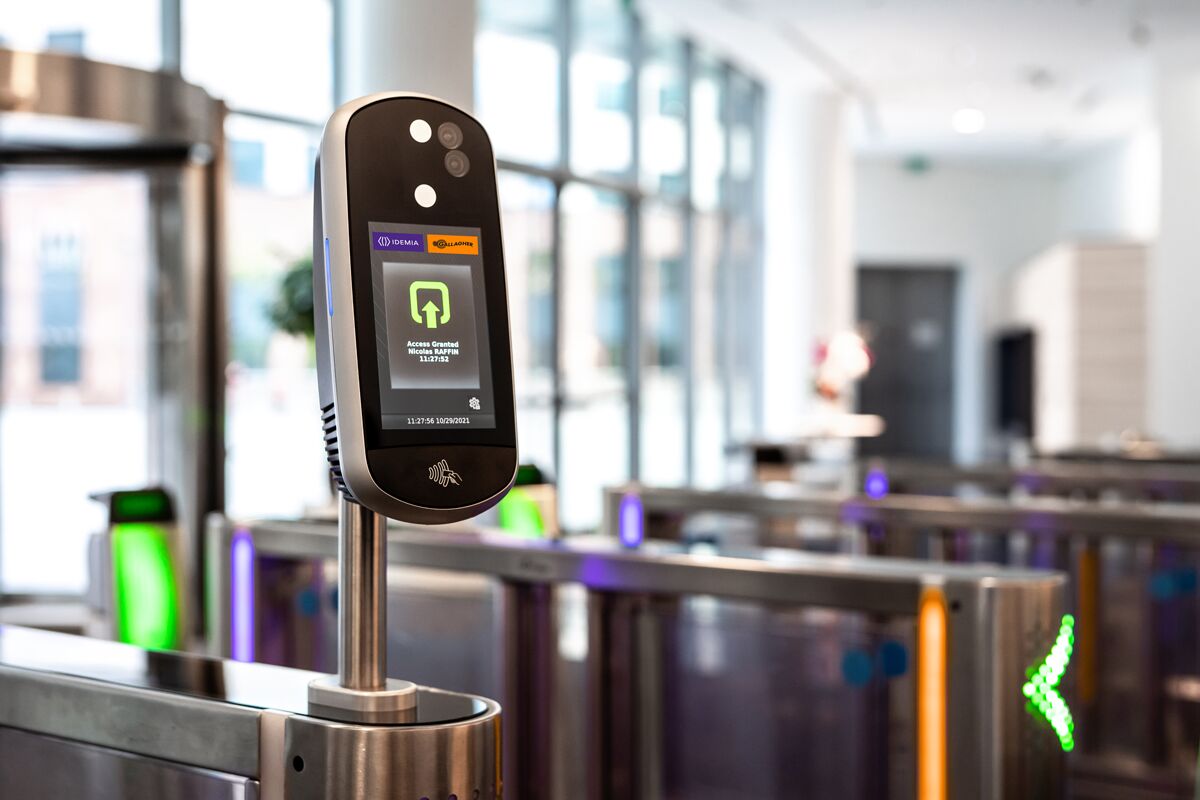
High security environments are under increased pressure as physical threats grow more sophisticated and operational complexity continues to rise. As organizations protect critical infrastructure, sensitive data, and human safety, the margin for error narrows, meaning access decisions based solely on legacy card technology or PINs are no longer enough.
Biometric access control enables a higher level of assurance by verifying the individual at the point of access, not just based on the credential they present. When integrated into a layered security strategy, biometric technologies, such as fingerprint, facial, and contactless wave recognition, strengthen protection against credential misuse, tailgating, and insider risk while supporting the speed, auditability, and compliance demands of modern operations.
This article explores five high consequence industries where biometrics deliver the greatest impact and how the integration between Gallagher’s Command Centre platform and IDEMIA Public Security’s biometric technologies deliver the identity assurance these environments need – without adding operational complexity for the teams managing them.
Why High-Security Environments Need Biometric Access Control
The most common access risks in high-security facilities aren’t sophisticated attacks, they’re familiar and operational.
- Credential sharing: cards or temporary passes shared between colleagues or never recalled after a role change.
- Tailgating: authorized entry exploited to allow unauthorized movement behind a legitimate user.
- Insider risk: authorized users access zones beyond their clearance.
- Lost or cloned credentials: particularly in high-volume, busy environments.
Biometric access control addresses these risks. A fingerprint, facial profile, or wave signature can’t be borrowed, forgotten or cloned the way a card can. Identity becomes the credential. And when deployed as part of a layered strategy, biometrics support non-repudiation expectations in high-security environments by tying access events to a person, not just something they carry or know.
By integrating IDEMIA Public Security’s biometric readers into Gallagher’s Command Centre, organizations gain higher confidence at the door through a unified system where identity verification and access decisions work seamlessly together.
1. Data Centers: Protecting Critical Infrastructure
Data Centers combine high-value physical assets with significant consequences for disruption. The risk isn’t just an external breach, it’s unauthorized movement within the facility and access to the wrong data hall, cage, or network area. A single breach can directly impact availability and result in financial loss, reputational damage, and regulatory penalties, making a layered physical security strategy, where identity assurance increases as users move closer to critical systems, essential.
With a unified platform approach, biometric readers can be selectively deployed at a facility’s most critical doors while access rules, authentication methods, and audit requirements remain centrally managed.
Where biometrics are typically deployed in a data center
Biometric access control is most effective at transition points where identity assurance must be high:
- Perimeter and main entrances
- Mantraps to enforce one-person-per-entry policies and prevent tailgating
- Critical internal doors including white space or main data halls
- High-risk maintenance areas where use of shared or temporary credentials is more likely
2. Healthcare: Ensuring HIPAA Compliance and Patient Safety
Healthcare environments face a unique security tension: access must be fast enough to support patient care while controlling entry to controlled substance storage and restricted clinical zones. When these competing demands aren’t managed well, they consequences fall on patients, staff, regulatory compliance.
Gallagher and IDEMIA Public Security’s integrated biometrics support HIPAA compliance within hospitals by creating irrefutable, auditable identity verification at the point of access – a defensible record of who entered, when, and under what conditions.
Contactless biometric options from IDEMIA Public Security extend this further in clinical environments, supporting hygiene protocols by eliminating shared touchpoints without introducing friction for staff.
Violence against healthcare workers is a growing concern, affecting 8% to 38% of professionals during their careers. As such, the need for effective security measures in high-stress environments like emergency departments, has never been more urgent. The Gallagher and IDEMIA Public Security integration addresses this through support for duress biometrics. Presenting a designated ‘duress’ finger unlocks a door as normal while triggering a silent alarm within Command Centre.
Where biometrics are typically deployed in healthcare settings
- Pharmacies and controlled drug storage
- Operating rooms and sterile zones
- Medical records storage and data/IT infrastructure rooms
- High-risk wards
- Lab areas and high-value equipment storage
3. Financial Institutions: Safeguarding Assets and Meeting PCI DSS Requirements
Vaults, cash handling areas, and payment infrastructure rooms carry significant fraud, coercion, and insider threats risks. The Payment Card Industry Data Security Standard (PCI DSS) mandates that physical access controls for these environments meet a high bar. Biometric access control gives financial institutions the high identity assurance required to protect these areas while maintaining the audit trails compliance requires.
In high‑risk financial environments, duress scenarios must also be accounted for. With duress biometrics, supported for fingerprint templates, access can be granted while a silent alarm is raised within Command Centre, allowing response teams to act without escalating risk at the door, supporting staff safety while maintaining security integrity.
Where biometrics are typically applied in the finance sector:
- Vaults, strong rooms, cash offices, and ATM servicing areas
- Data rooms or server cages supporting payment systems
- Secure document archives and trading/operations floors
- Third-party access points (maintenance providers, cash-in-transit interfaces)
4. Pharmaceutical and Research Labs: Protecting Intellectual Property
Pharmaceutical and research labs face a unique challenge: the people who need access often use Personal Protective Equipment (PPE), cleanroom protocols, and strict procedural requirements that complicate conventional credential use. At the same time, these environments are still required to produce a precise record of who accessed what and when to adhere to FDA requirements, GxP compliance frameworks and chain-of-custody accountability.
Biometrics resolve this challenge. Identity-based access control removes reliance on shared or passed credentials and delivers the documented access history that FDA audits and research integrity frameworks require. The Gallagher and IDEMIA Public Security integration enables this accountability to be enforced at the door and managed centrally across sites, zones, and authentication levels.
Where biometrics are typically deployed in research labs
- Cleanrooms and restricted lab suites
- Sample storage areas and controlled substance zones
- R&D areas with sensitive documentation and prototypes
- High-value manufacturing process areas
5. Aviation: Meeting TSA Security Standards and Protecting Secure Areas
Airports and aviation facilities are among the most operationally complex access control environments. Employees, contractors, vendors, logistics, and operations teams are constantly moving through secure areas under time pressure and across multiple organizations with different clearance profiles. In this environment, credential misuse is a realistic operational risk at scale.
Aviation biometric security strengthens identity assurance at critical transition points like airside zones, cargo handling, and restricted operational zones, while supporting the throughput that airport operations demand. The Gallagher and IDEMIA Public Security integration provides auditability across these points with creating bottlenecks that push compliance behavior into workarounds.
Where biometrics are commonly deployed in aviation:
- Airside access points and restricted operational doors
- Cargo handling areas and screened logistics zones
- Maintenance hangars and critical infrastructure rooms
- Staff-only corridors with high-throughput access needs
Better Together: What the Gallagher and IDEMIA Public Security Integration Delivers
The strongest biometric deployments aren’t built from best-of-breed hardware bolted onto separate management systems. They come from platforms where enrolment, template governance, alarms, and access decisions work together, reducing the operational burden on security teams while raising identity assurance at the door.
The Gallagher and IDEMIA Public Security integration delivers this through a genuinely unified architecture. This integration pairs IDEMIA Public Security’s high-performance biometric technologies with Gallagher’s centralized decision-making, delivering higher assurance while keeping operations simple for security teams.
One platform, not two
Biometric enrollment and template management are conducted within Command Centre, eliminating the need to purchase, maintain, and train staff on two entirely separate systems.
A complete security picture at every door
Access control, perimeter security, and intruder detection are natively integrated within Command Centre, so biometric access events sit within a broader operational context, giving teams the situational awareness to respond.
Antifraud capabilities built in
Gallagher’s integration with IDEMIA Public Security supports stronger identity assurance through antifraud capabilities like fake finger detection and facial spoof detection, duress functions, and privacy-aware template handling, helping organizations meet stringent security and compliance expectations without adding operational friction.
Certified at the foundation
Gallagher holds rigorous certifications, including FIPS 201-3 compliance, NPSA approvals, and ISO 27001 certification. While IDEMIA Public Security’s algorithms receive high ratings from the National Institute of Standards and Technology (NIST).
Privacy-aware by design
Enrolled biometric templates can be encoded directly to a MIFARE DESFire smartcard rather than being stored in server memory, ensuring users retain full control of their biometric data.
Secure Your Facility with Integrated Biometric Access Control
The Gallagher and IDEMIA Public Security integration brings together two proven platforms delivering identity assurance that meets the compliance demands, audit expectations, and operational realities of environments where the stakes are highest.
To explore how an integrated biometric access control approach could work in your environment, contact your Gallagher representative today.
Gallagher and IDEMIA Public Security. Better Together.