Picture this: you’re at the airport, moving through check-in, customs, and security before boarding your flight and setting off for your destination. Your passport has been checked numerous times (and you’ve made sure it’s still in your pocket or bag more times than you’d like to admit).
As you move through the airport journey, you know the drill. Familiar layers of security guide you every step of the way – from entering the airside environment and boarding the aircraft to disembarking at your destination – all designed to keep us safe.
But can we say the same about the wider airport site – its runways, airfield land, service roads, and perimeter fencing?
You may have recently seen dramatic footage of perimeter breaches at airports. Last year, a person was detained after climbing a perimeter fence and gaining access to an aircraft. In a separate incident, another individual exploited a gap in an airport fence to gain access to an aircraft.
Incidents like these put people at risk, significantly disrupt airport operations and air travel, and erode public confidence in aviation security.
They’re also a powerful reminder that security layers must extend beyond the passenger journey. And when it comes to perimeter security, we're talking about much more than a physical fence.
With kilometres of fencing around critical locations like airports, the importance of having a security solution with strong, reliable detection and safe deterrence capabilities cannot be overstated.
A perimeter is the first active control in a site’s security architecture, determining how early a threat is detected and how effectively a response can be initiated.
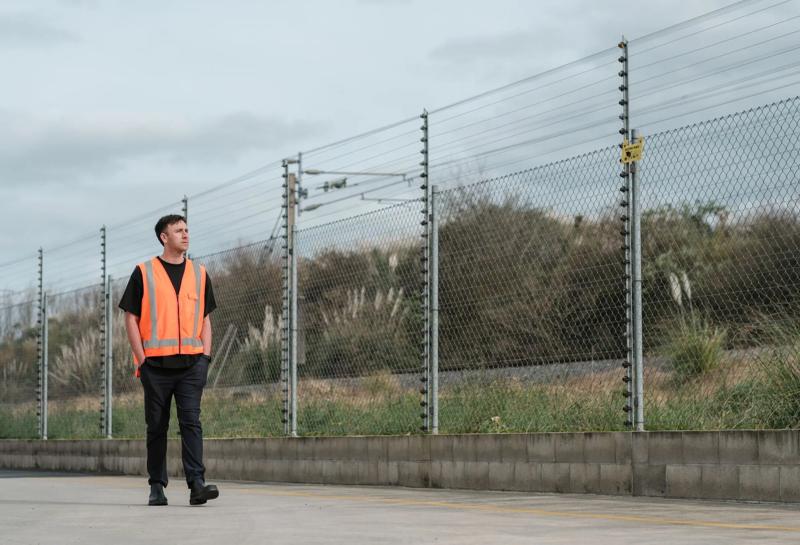
Monitored Pulse Fence has become one of the most trusted perimeter security solutions available. It’s designed to act as a strong deterrent while maintaining a focus on safety rather than causing physical harm.
The safety of fence controllers and installation practices is governed by international standards that define product and installation requirements, helping ensure these systems remain both effective and safe.
Effective perimeter security relies on the three Ds: Deter, Detect, and Delay. While detection is arguably the most critical element, it cannot protect a site in isolation.
A connected, curb-to-core security solution provides the multi-layered protection needed to secure an entire site.
On top of this, cyber security threats are becoming an increasingly significant challenge to perimeter protection and are forcing a rethink in how and what technologies are installed, with a shift toward more intelligent and integrated solutions.
Airports, data centres, utilities, and transport operations are moving away from fragmented, detection-only, legacy perimeter systems and are instead shifting towards integrated perimeter ecosystems, where sensors, communications, and monitoring platforms are designed as a unified system. This provides consistent detection, response, and cyber resilience across sites to reduce risks.
Integration with other security technologies is essential for any intelligent perimeter solution. It ensures control room operators get the right information, in the right format, at the right time, so they can respond quickly and effectively.
One of the biggest advantages of an intelligent perimeter system is its simplicity. When operators can manage everything through a single application, it is significantly easier to monitor security and quickly understand what’s happening when an alert comes through.
In turn, this streamlined approach helps improve day-to-day operations and can drive greater efficiency across the business.
While the passenger journey is tightly controlled and continuously refined, the same level of focus and rigour must be applied to protecting the wider airport environment.