
Security teams have access to more information than ever before.
Access control events, video, alarms, identity data, sensors, and other connected technologies continuously generate information about what is happening across an organization. The challenge is no longer simply collecting that information or making it available.
The challenge is having access to the data in a meaningful view that provides actionable intelligence.
An Operational Intelligence Platform (OIP) helps organizations turn siloed information from across their security and operational environments into contextual insights that improve response time and outcomes.
By connecting relevant data, identifying relationships, and surfacing meaningful insights, OIP can help security teams understand what is happening, prioritize what requires attention, and make more informed decisions.
For organizations managing complex or distributed environments, this represents an important shift: moving beyond monitoring individual events toward unlocking the bigger operational picture.
Key takeaways
- An Operational Intelligence Platform (OIP) brings information from multiple sources into a common operational context.
- OIP goes beyond system integration by helping identify relationships and meaning across events and data.
- Actionable intelligence provides the context security teams need to determine what matters and what may require attention.
- OIP can help organizations reduce the manual effort involved in searching across systems and interpreting information.
- Operational intelligence can support a more proactive approach to security operations.
- Gallagher Security and Luxriot are bringing this approach to life by connecting Gallagher Command Centre with Luxriot EVO's video and operational intelligence capabilities.
What is an Operational Intelligence Platform?
An Operational Intelligence Platform is a technology platform designed to bring together relevant operational information, add context, identify meaningful relationships, and surface insights that can support timely decision-making.
In physical security, this means connecting information from across the security environment and helping teams understand how individual events may relate to one another.
The distinction is important. A security system can tell you that something happened. An Operational Intelligence Platform can help provide the context needed to understand what that event means and serving up the insights to respond quickly.
For example, an access event at a restricted entrance may be completely routine. But if that access occurs outside normal operating hours, involves a credential that is not typically used at that location and coincides with other unusual activity, the broader situation may warrant attention.
The information needed to understand the situation may already exist within the organization's security environment; a correlated view of the data may not be easily accessible if systems are siloed. The value of the OIP is in helping contextualize those pieces of information into a unified view/workspace for real-time awareness, relational insight and faster, more-informed decisions.
What is Operational Intelligence in physical security?
Operational intelligence is the use of timely information, context, and analysis to understand what is happening within an environment and support informed decisions.
For physical security, this means looking beyond isolated events.
Security teams routinely manage information from multiple sensors and technologies. Each system provides a different piece of information, but individual events do not always provide enough context to understand their significance.
Operational intelligence helps put those pieces together.
Instead of asking only: What happened?
Security teams can begin asking:
- What else is happening around this event?
- Is this activity expected?
- Are there relationships between multiple events?
- Does the activity appear unusual?
- What information is relevant to the situation?
- Does this require further investigation or action?
This broader context can help security professionals focus their expertise where it matters most.
How does an Operational Intelligence Platform work?
An OIP can help transform information into actionable intelligence through several connected steps:
- Connect
- Contextualize
- Correlate
- Surface
- Act
Connect relevant information
Organizations already generate information across numerous security and operational systems.
An OIP can bring relevant information from these sources together, creating a more unified operational view and reducing the need for teams to investigate every source independently.
Add context
An individual event rarely tells the whole story. Context can include information such as:
- Who was involved
- What happened
- Where it occurred
- When it occurred
- What other activity was occurring nearby
- Whether the activity aligns with expected patterns
Adding this context can help distinguish routine activity from situations that may deserve further attention.
Identify relationships
Events that appear unrelated when viewed individually can become meaningful when considered together.
An OIP can help identify relationships between events and information, giving security teams a clearer understanding of what may be happening across their environment.
This can be particularly valuable in complex or distributed environments, where the information needed to understand a situation may otherwise be spread across multiple systems or locations.
Surface actionable insights
Connecting information is only part of the value.
An OIP can help surface information that may be relevant to a particular situation, rather than requiring operators to manually search through every available source.
This allows teams to spend less time finding information and more time evaluating what it means.
Support informed action
An OIP does not replace the experience or judgment of security professionals. Instead, it gives them more relevant information and context to help determine what action may be appropriate.
The goal is not to automate every security decision, the goal is to strengthen human decision-making with better intelligence.
Operational intelligence vs. security integration: what's the difference?
Integration has played an important role in modern security environments.
Connecting systems allow technologies to exchange information, share data, and perform functions together, but integration alone does not necessarily explain what that information means.
An integrated environment may allow an access control event and a video event to exist within the same connected ecosystem. However, an OIP builds on that foundation by helping organizations understand the relationship between those events and the broader context surrounding them.
The difference can be summarized simply.
- Integration: Systems can communicate and share information.
- Operational intelligence: Information from those systems can be understood in context to help identify what matters. This is an important distinction as security environments become increasingly connected.
There is no question that in today’s environment devices and sensors are connected and surfacing data, but data alone doesn’t provide the correlated insights. Operational intelligence leverages the data from those connected devices and integrated technologies and creates the actionable intelligence to support better and timely decision making.
What can an Operational Intelligence Platform be used for?
Operational intelligence can support a range of security and operational activities, particularly within organizations managing large, complex or distributed environments.
Security operations
OIP can help teams understand activity across their security environment and identify situations that may require attention.
By providing additional context around events, teams can spend less time piecing information together manually.
Incident investigation
When an event occurs, understanding what happened before, during, and around it can be just as important as the initial alert.
Connecting relevant information can provide investigators with a broader picture and help reduce the need to search through multiple sources independently and simplify reporting.
Situational awareness
Organizations with multiple sites, facilities, or operational environments can benefit from having a more unified view of activity across their footprint.
Rather than looking at each event in isolation, teams can gain greater visibility into what is happening across the environment.
Identifying patterns and trends
Individual events may not appear significant. Patterns across multiple events can provide a different perspective.
Operational intelligence can help organizations identify relationships and activity patterns that may otherwise require significant manual analysis.
Operational reporting
Security environments generate large amounts of operational data.
Putting that information into context can help organizations turn raw activity into reporting that provides greater visibility into what is happening across their environment.
Business planning
Security information can also provide value beyond day-to-day security operations.
When operational data is brought together and contextualized, organizations can gain insights that can support broader planning and decision-making.
Why does operational intelligence matter for enterprise security?
The complexity of physical security environments continues to increase.
Organizations may manage multiple locations, thousands of credentials, extensive video infrastructure, numerous access points, and a growing number of connected systems and sensors.
At the same time, security teams still need to quickly determine what deserves attention, with information that outnumbers the people pulling it all together. More information does not necessarily make that easier.
In fact, without context, additional information can create more work for the people responsible for interpreting it. Instead of requiring security teams to:
- Search
- Compare
- Interpret
- Prioritize
Decide OIP can help move the process toward:
- Understand
- Prioritize
- Decide
- Act
This can help security professionals spend less time searching for information and more time applying their experience and judgment to the situations that matter.
Making existing security information more valuable
One of the opportunities with an Operational Intelligence Platform is that organizations do not necessarily need to begin by adding more technology.
They can begin by making better use of the information their existing environment already produces
- Access control records activity.
- Video provides visual context.
- Alarms identify events.
- Sensors provide additional information about the environment.
- Other connected systems can provide further operational data.
The opportunity is to bring relevant information together and make the resulting intelligence more useful.
This is an important shift in how organizations can think about security technology.
Gallagher and Luxriot: bringing operational intelligence to physical security
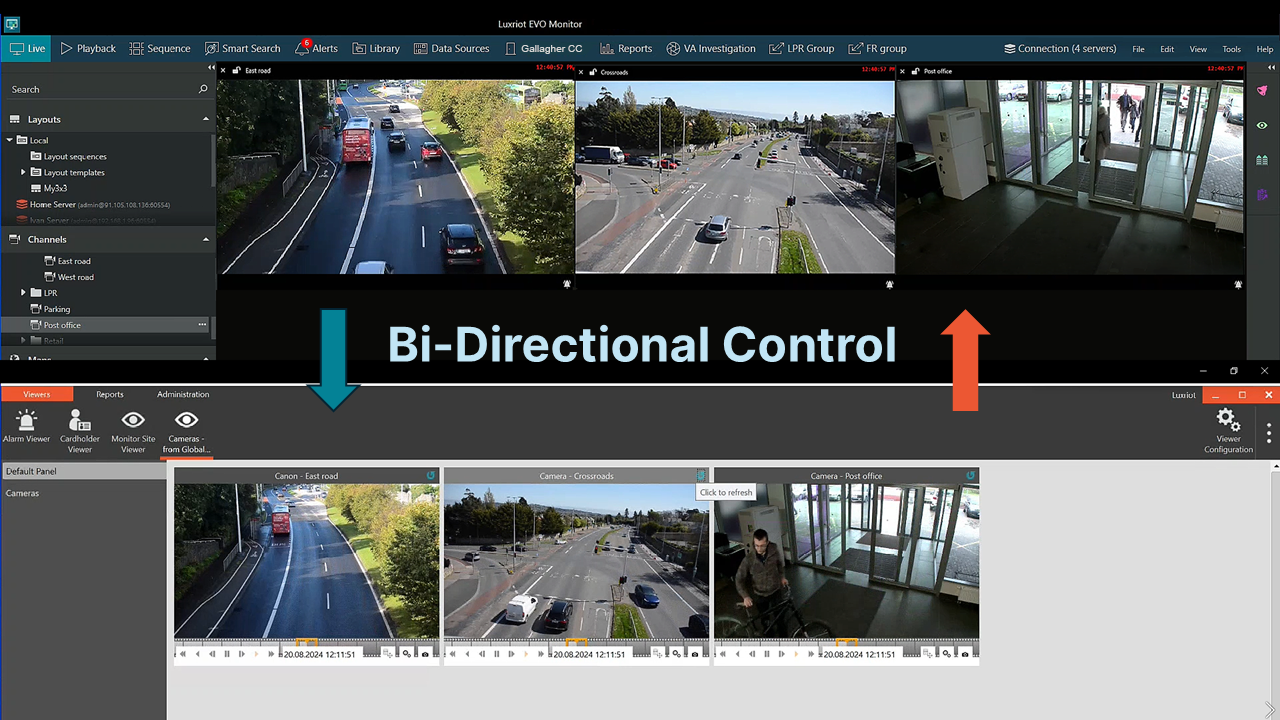
Gallagher Security and Luxriot are bringing the concept of operational intelligence to life through a unified approach that combines Gallagher Command Centre with Luxriot Evo's video and operational intelligence capabilities.
The bi-directional interface connects the two technologies to bring together video, data, events, and access control within a unified operational environment.
For organizations managing complex or distributed environments, this can provide a more connected view of activity across their security footprint.
The result is a more unified operational view designed to help security teams understand what is happening, determine what matters and make informed decisions.
From security data to actionable intelligence
The value of an Operational Intelligence Platform ultimately comes down to what organizations can do with the information they already have.
Data on its own provides individual pieces of information. Context gives those pieces meaning. Relationships help reveal the bigger picture. Actionable intelligence helps security professionals determine what deserves attention and what should happen next.
That progression represents the opportunity behind OIP:
- Turn data into context.
- Turn context into actionable intelligence.
- Turn intelligence into informed action.
As security environments continue to become more connected and complex, organizations will have more information available to them.
The opportunity is to make that information work harder.
With Gallagher Command Centre and Luxriot's video and operational intelligence technology working together, organizations can take a more connected approach to security operations using the information already being generated across their environment to gain greater context, surface meaningful insights, and support better-informed decisions.